



Threads of Dance and Drama / The beauty and diversity of Kanjivarams in the world of costume design
तन्त्रमेके युवती विरूपे अभ्याक्रामं वयतः षण्मयूखम् ।
प्रान्या तन्तूंस्तिरते धत्ते अन्या नाप वृञ्जाते न गमातो अन्तम् ॥ ४२ ॥
Two maidens—Day and Night—move with light and darkness as their companions. The six pegs that hold the frame reflect the six directions. As the maidens weave the warp and the weft, a Male figure steps in to give the fabric its final form, fixing its length and extending it endlessly. This Male embodies Purusha, the Ultimate Being.
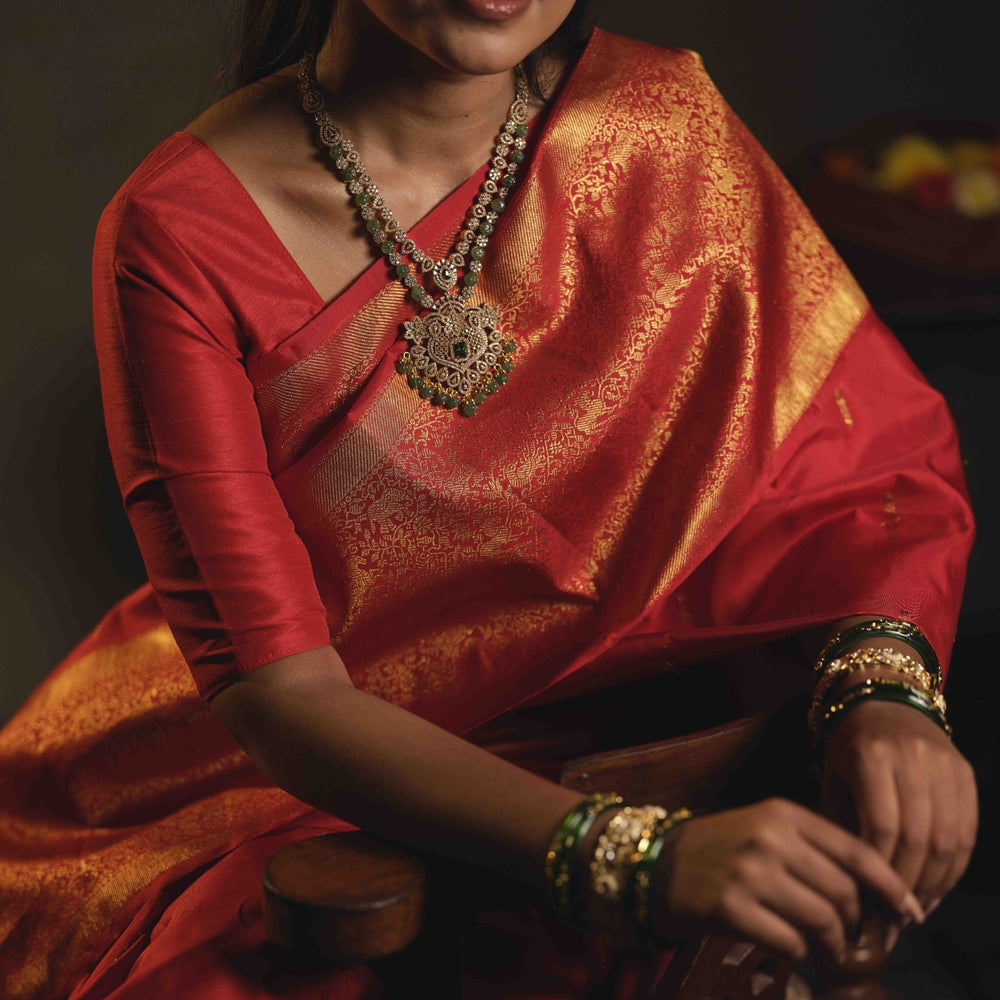
Handloom finds mention as early as the Atharva Veda and has always been interwoven with our cultural fabric—sometimes through philosophy, and sometimes simply through tradition passed down quietly across generations. Over time, it evolved alongside the aesthetics of classical art forms, becoming central to costumes in the South. From traditional motifs to the creation of the “Padma” motif dedicated to Dr. Padma Subramanyam, the iconic M.S. Blue inspired by the beloved M. S. Subbulakshmi, and the distinctive Kalakshetra looms, the saree gradually became much more than attire—it became expression.
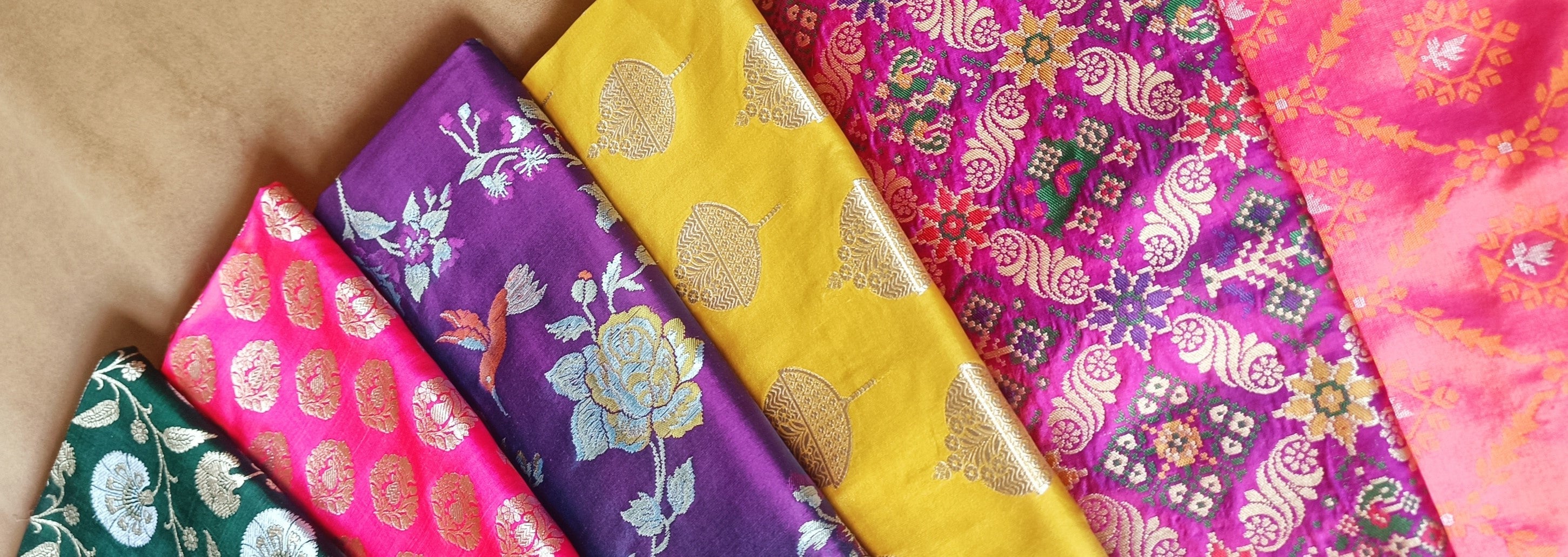
Traditional colours and motifs, too, began representing Indian aesthetics on stage. Shades like Arakku (deep lac red), Taamarai (lotus pink), Kili Pachai (parrot green), Mampazham (mango yellow), Kanakambaram (soft orange), and Vadamalli (magenta) illuminated dancers against dark backdrops, making performances visually striking and deeply memorable.
But this raises an interesting question: how did particular saree and costume colours come to symbolize certain characters in epics or theatre? To explore this, we are gently led back to the Natyashastra.
The Natyashastra outlines the Nava Rasas—the nine subtle emotional states—and links each to specific deities, colours, swaras, and purusharthas. Shyama (dark blue) evokes Sringara; Gaura (yellowish cream) signifies Veeram; Rakta (red) expresses anger; black embodies Bhayanaka (fear); Shweta (white) denotes Hasyam; grey reflects Karuna; Neela (blue) conveys Vibhatsyam (disgust); and yellow suggests Adbhutam (wonder). These associations quietly inform the visual grammar of performance.

Rama Vanagamanam by Kalakshetra Foundation
Take, for instance, Rama Vanagamanam by the Kalakshetra Foundation. When we view a character through the lens of performance, we realise that no persona is shaped by a single Rasa alone. In the Ramayana episode of Rama’s exile, Sita is portrayed as innocent—the epic notes she did not even know how to wear Valkala Vastram—yet she is also resolute, determined to walk beside Rama into Dandāranyakam. To reflect this layered personality, she is often costumed in cream and orange in Kalakshetra dance-dramas, visually expressing both purity and strength.
At the same time, costume colour does not always follow theory strictly. Much depends on the choreographer’s sensitivity to the emotional tone of the production. Some colour meanings emerge from nature; others arise from cultural interpretation. Orange, for instance, became associated with spirituality because it was the hue of the sanyasi’s ochre robes—a mark of renunciation. Red and pink came to embody Sringara, indigo and purple suggested royalty, and earthy tones became inseparable from figures like the Buddha. These associations guide artists in ways that are both subtle and profound.

Magdalana Mariam by Anjana Anand
A compelling example is Magdalana Mariam by Anjana Anand. The portrayal of Mary Magdalene—drawn from the Malayalam poetry of Mahakavi Vallathol Narayana Menon—offers a rarely explored subject in classical performance. Here, white is not chosen merely for aesthetic appeal. It reflects innocence, purity, and the character’s Christian inheritance. The costume becomes a quiet narrative device, revealing emotional and spiritual identity even before movement begins.
Regional diversity adds yet another dimension. Consider the Ramayana as presented by the Apsara Dance Company. Though Cambodia and India are geographically distinct, they share epic traditions. In this production, sarees and sampots take on a different visual language. Golden yellows and deep bronzes of Southeast Asian silk create a celestial aesthetic quite unlike the heavy temple borders of South India. Here, while the Rasa remains universal, the “soil” of the region shapes the palette. Through local weaving traditions—whether intricate Ikat or shimmering zari—choreographers signal status, geography, and lineage without uttering a single word.

Ramayana by Apsara Dance Company
Ultimately, handloom’s hue is never just a visual choice. It absorbs the emotional and philosophical currents of the arts and their protagonists. It is at this meeting point of warp and weft that cloth transforms into narrative—where costume ceases to be mere fabric and begins to speak of the infinite.